What protein do you wish existed?
Say what the protein has to do - our AI works out how to build it.
a protein that cuts PET at 85 °C in an industrial washing line, alkaline detergent, and doesn’t step on anyone’s patent
or
the protein we already use - same job, minus the two places it cuts that we don’t want
What comes back is a decision and the evidence behind it. The wet lab stays yours.
How it works.
Where it starts
You don’t need to know how to build it.
Most tools want the answer already half-formed. Vidika’s AI starts at the problem - and it reads before it builds.
based on the TnpB IsDra nuclease, design an improved version with a more tolerant TAM
Vidika’s AI reads two records at once
The literature
The consensus and the prior art a design has to be informed by - and it cites its sources.
PubMed · Semantic ScholarOther fields entirely
Structural principles from architecture, network geometry and physics - the ones a biologist would not surface.
Semantic ScholarOnly if you ask for it
The patent record
What the record shows. Evidence, never a legal opinion, and never that a design is safe to sell.
Patent searchWhere this idea came from
Every idea in the plan carries the paper it came from.
Cre recombinase uses conformational equilibrium between autoinhibited and active states to control specificity - structural gating rather than base contacts alone.
Read the paper 10.1021/acs.biochem.4c00841
reading, searching, modelling, ranking - all at once, not one thing after another. The bench still takes what the bench takes.
Before building
Vidika asks only what cannot be worked out.
The rest is worked out for you. What is left is a real choice, and it is yours.
Which delivery route is the technical bottleneck for the 500 AA constraint?
Identifies whether protein size or biochemical properties are the limiting factor.
None of these - I’ll say it in my own words
Your choice
Three ways to build it. You choose.
Several routes are scored before one is committed to. Take a different one later and the first attempt stays - nothing is overwritten.
Target-Conditioned TAM Pocket Redesign
A 408-residue TnpB variant with its TAM-contacting residues explicitly redesigned to tolerate non-TTGAT motifs.
Secondary Shell Conformational Gating
A TnpB IsDra variant with a relaxed secondary shell, introducing conformational flexibility to the TAM pocket.
Guide-RNA Interface Relaxation
A TnpB IsDra variant with an optimized guide-RNA interface that accommodates non-canonical R-loop geometries.
Each percentage is the chance it clears the six requirements we can check here. Not a claim about the bench.
What comes back
A prediction is not a measurement.
A strong fold score is not a measured site. Every number came out of the instrument that produced it, and anything only your bench can settle is named as exactly that.
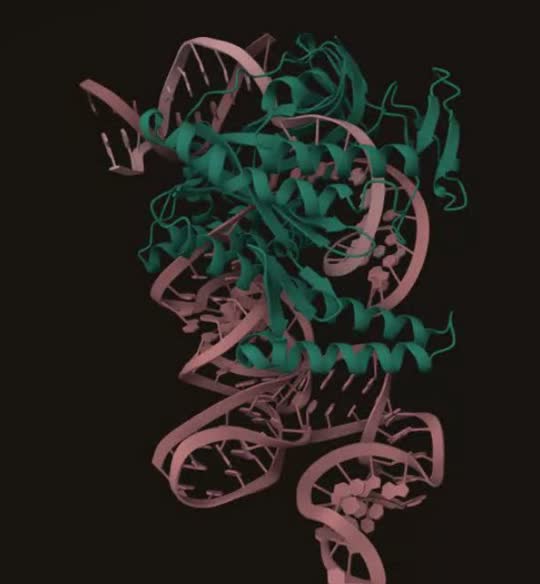
The design is ready.
The instruments
Seventeen instruments, and the judgement to pick between them.
A narrow set understood properly is worth more than a catalogue of three hundred nobody has read. All but the two public sequence searches run on our own machines.
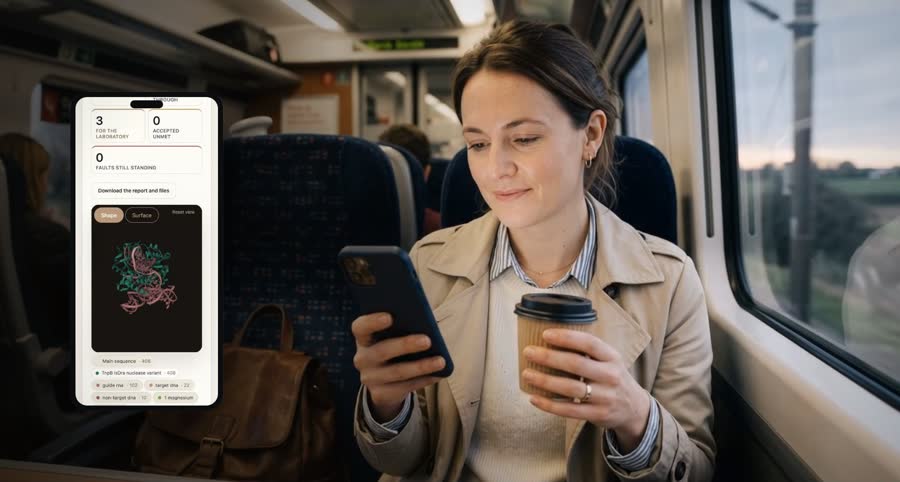
From your phone
All of it, start to finish, wherever you are.
Why you can trust the answer
Five things this AI is never allowed to do.
An AI that invents things is worse than no AI at all. These are not guidelines. They are checks in the code, and a request that breaks one is refused.
Never give you a number it did not measure. If no instrument produced it, you get no number - never a plausible-looking guess.
Never write a sequence from memory. Every sequence and every reference is fetched fresh from a source you can open yourself.
Never score a molecule it cannot prove it built. If a candidate cannot be traced back to the machine that made it, it is thrown away rather than reported.
Never cut corners to finish sooner. If a job does not fit the time it was given, the clock was wrong - not the design.
Never quietly skip what it could not test. Anything only your bench can settle is labelled as exactly that, right beside everything it did prove.
And what we don’t claim
We publish no performance claims. Until designs have been made and tested by a lab that is not us - and we can say out of how many, against what, and who took the reading - there is no number here worth quoting.
So - what protein do you wish existed?
Ask for the whole thing, not the safe half of it.
Invitation only, for now.